Regions
Deploy your infrastructure closer to your users.
A Region is a specific geographical location where our data centers reside. Choosing the right region is crucial for minimizing latency, complying with data governance laws, and ensuring the highest possible performance for your application's users.
Available Regions
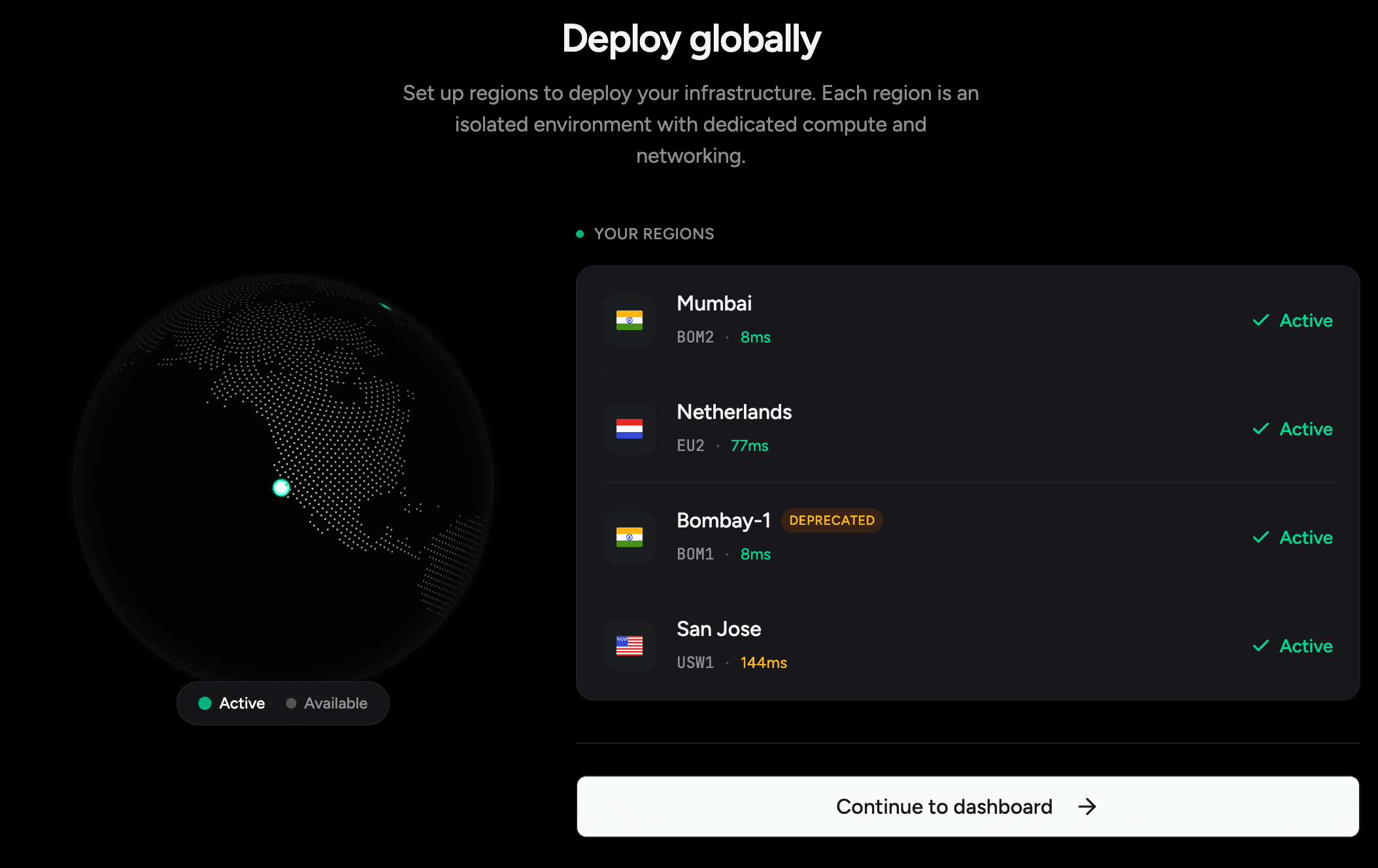
We continually expand our global footprint. When you provision resources like Virtual Machines, Kubernetes clusters, or Load Balancers, you will be prompted to select a Region. Currently available regions are shown in the Regions section of the dashboard along with their status.
Choosing a Region
When deciding where to deploy your resources, consider the following factors:
- Proximity: Deploy closest to where the majority of your users are located to minimize network latency.
- Compliance: Certain industries or countries have data residency requirements that dictate data must be stored within a specific geographic boundary.
- Redundancy: For mission-critical applications, consider deploying resources across multiple regions to ensure high availability in the event of a regional outage.
Multi-Region Architectures
For global applications, a multi-region setup involves replicating your workload across several Regions and using intelligent DNS routing (like Geo-DNS) or Global Load Balancing to route users to the nearest healthy deployment. While more complex to manage, it provides the ultimate resilience and user experience.
Resource Isolation
Resources provisioned in one Region are generally completely isolated from resources in another Region. For example, Private Networks do not stretch across regions; they are localized to the Region in which they are created.